


Originally drafted April 2018, completed after several months of additional thinking
I encountered something peculiar the other day while taking an online quiz. A simple question about directions, left versus right, completely threw me off. Not because I don't know my directions, but because the system's perspective didn't match mine. It was a 50-50 guess, and I got it wrong. To set the scene, this happens to be more often in every day conversations, you know, when someone says look left, and then the inevitable follow-up questions arises, whose left?!
This got me thinking about heads-up displays in cars and the emerging world of augmented reality interfaces. That small directional confusion.
When reference frames collide
In current automotive HUDs, directional instructions work because everyone shares the same forward-facing orientation. "Turn left" means the same thing to the driver, the vehicle, and the road ahead. But this alignment is more fragile than it appears.
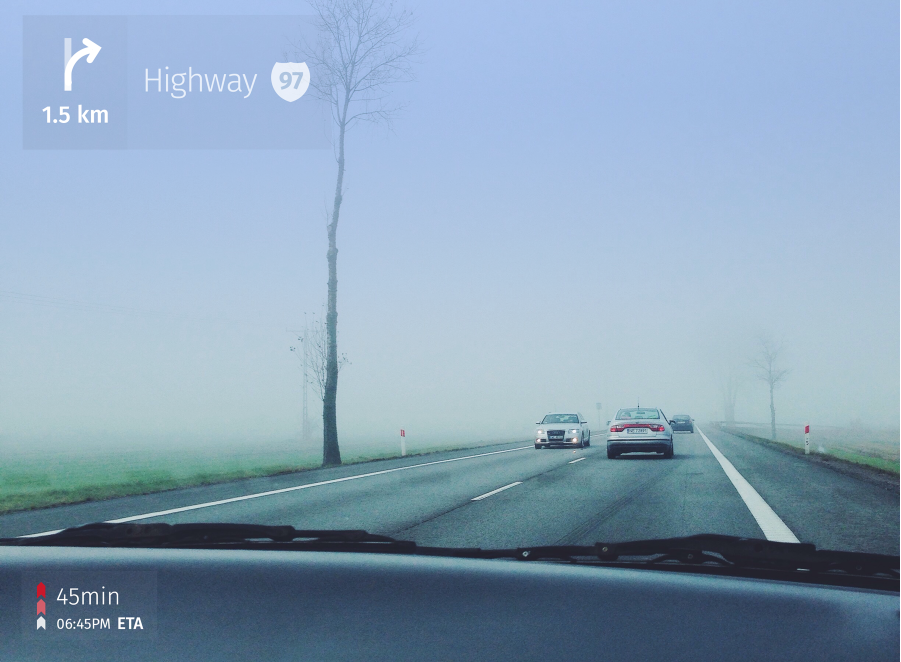
Consider what happens when we extend beyond the driver's windscreen. Passenger-side displays, rear-view augmentations, or side-window overlays each introduce their own relative orientation. The reference frame that worked perfectly for a single forward-facing user suddenly becomes ambiguous.
The mobile maps got this right early on. They instruct from the user's perspective, rotating the view to match your orientation. But as we move beyond phone screens to AR interfaces, AR windscreens, passenger entertainment, augmented reality navigation, this perspective alignment becomes exponentially more complex.
Beyond the windscreen
Here's where it gets interesting: imagine AR displays on passenger windows showing contextual information about passing landmarks. Or rear-window displays helping with parking. Each surface has its own context to the user, its own reference frame.
The engineering challenge isn't just technical, it's cognitive. We're designing for multiple users with different orientations, viewing angles, and mental models, all sharing the same physical space but experiencing different digital layers.
The bigger picture
What started as a trivial quiz question reveals something fundamental about AR interface design. Every directional instruction, every gesture, every "over there" in an AR interface carries an assumption about shared perspective.
As augmented reality moves from concept to cockpit, getting this right isn't just about user experience, it's about safety. The difference between "turn left" and "turn right" in a navigation system isn't a minor interface issue; it's potentially life-threatening.
The solution isn't universal. It's contextual, adaptive, and deeply rooted in understanding not just what users need to do, but how they naturally orient themselves in physical and digital space.
Sometimes the smallest details reveal the largest design challenges. In AR computing & design, there's no such thing as a trivial directional problem.